YouByute Flexi Tape
Flexible Butyl Rubber Tape

 Product Description
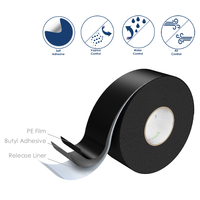
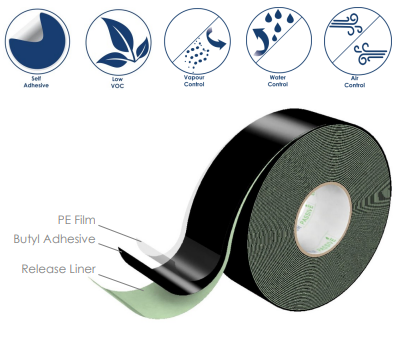
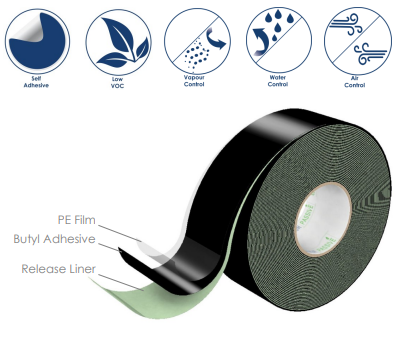
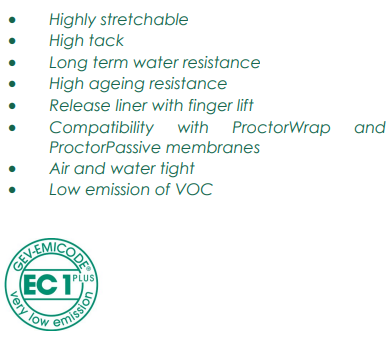
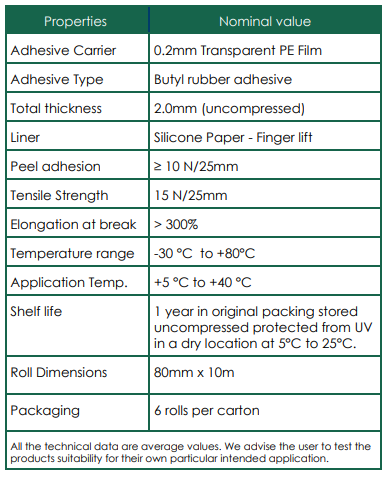
ProctorPassive YouByute Flexi Tape is a strong adhesion highly stretchable PE butyl rubber tape with lasting water and ageing resistance.
Applications
ProctorPassive YouByute Flexi Tape is used in roof and wall construction as a tape for permanent sealing of air barriers, roof underlays, building wraps and around doors, windows and pipes. The tape is suitable for sealing overlaps in edges and corners and locations that require a high degree of flexibility in the tape.
Installation
As with all pressure sensitive tapes, the YouByute Flexi Tape should be bonded as tension-free as possible. In order to ensure a strong bond, apply pressure with a squeegee or roller when applying the tape. Adhesion can be improved by applying higher pressure. The tape must not to be used for bonding under mechanical load. The use of tape is not a substitute for any required fixing of materials. Surfaces being adhered must be dry and free of surfactants, tensides, release agents like grease or oil, and dirt or dust. Damp or cold surfaces may prove difficult to adhere to and should be allowed to dry and return to a temperature between +5°C + 40°C prior to application of tape. It is recommended that porous or sandy surfaces being adhered to are preconditioned with a suitable primer. Due to the risk of plasticizer migration, the product‘s suitability on plastics and rubber should be tested.
YouByute Flexi Tape: Sealing the Gaps Standard Tape Misses
A lap join is one kind of gap. A nail or screw punched through a membrane is a different one, but there are dozens or hundreds of them across a single wall or roof, and everyone is a potential path for air and moisture to move through a barrier that's meant to be sealed. YouByute Flexi Tape is built specifically for sealing individual penetration points rather than long lap runs.
It's easy to spec a membrane and a lap tape properly and still end up with a building envelope that leaks air, simply because nobody thought about the hundreds of small holes created by every fixing that holds the membrane in place. Those fixings are necessary as the membrane must be attached somehow, but each one is technically a breach in what's supposed to be a continuous barrier. YouByute Flexi Tape exists to close that gap in the spec.
Why Penetration Points Get Missed
Most tape products on a job are speccing for long, straight runs where a standard tape width and application method work fine. Fixing points don't fit that pattern. They're small, they're everywhere, and taping each one properly with a general lap tape is slow and often skipped once trades are moving fast to keep on schedule.
On a typical wall or roof run, the number of individual fixing points can run into the hundreds once you count fasteners for the membrane itself, battens, and any other layer fixed through the barrier. Sealing each one with a lap tape designed for long straight joins is impractical, the application method is wrong, and the labour time to do it properly with the wrong product would make the job uneconomical. That's exactly the gap this product is built to fill.
Nail and Screw Penetration Sealing
YouByute Flexi Tape is built around sealing the nail and screw penetrations that hold sarking, wall wrap or battens in place. Each fixing point is a small breach in the airtightness of the barrier, and left unsealed, enough of them add up to a real gap in performance.
Individually, a single unsealed fixing point might seem negligible, but building science research consistently shows that aggregated small leaks across a building envelope contribute meaningfully to overall air leakage often more than people expect from what looks like a minor detail.
Airtightness Tape — What's Actually at Stake
An airtight building envelope isn't just about draughts. Uncontrolled air movement through unsealed penetration points undermines insulation performance and can carry moisture vapour through the wall assembly at exactly the points you don't want it — around every fixing.
Insulation performance depends heavily on the building envelope being airtight, not just insulated. Air moving freely through gaps around fixings bypasses the insulation layer entirely, carrying conditioned air out (or unconditioned air in) regardless of how good the insulation batts or blanket are elsewhere in the wall. That's part of why energy efficiency standards have increasingly focused on airtightness testing alongside insulation R-values.
Flexi Tape, Not Rigid Tape
The "flexi" in the name matters here. A rigid tape doesn't conform well to the small, irregular shape around a nail or screw head. A flexible tape moulds to the fixing itself, which is where the actual seal happens. A rigid tape applied over a fixing point often looks sealed on the surface while leaving a small void directly around the fastener head where the tape couldn't conform exactly the gap the product is meant to close, still open underneath a tape that appears to be doing its job.
Application at Scale
Given the sheer number of fixing points on a typical job, ease and speed of application matters as much as the seal quality itself. A product that's fiddly to apply per fixing point simply won't get used consistently across every single one once a crew is moving through a long run, which is why the practical, hands-on usability of a penetration sealing tape is as important to its real-world performance as its lab-tested adhesion figures.
Where YouByute Flexi Tape Fits in the Build
Used alongside your membrane and lap tape system, YouByute isn't a replacement for HighTack Plus or a general lap tape, it's the product that covers the gap those tapes aren't designed to seal. Speccing both together is what gets you a genuinely sealed envelope rather than one with a few hundred small holes in it.
Think of it as a three-part system rather than a single product decision: the membrane provides the barrier itself, the lap tape seals the joins between membrane sheets, and the penetration sealing tape closes the fixing points across the field of the membrane. Leaving any one of those three out of the spec undermines the other two, no matter how well they're individually installed.
Application Tips for Penetration Sealing
Consistency Across the Whole Run
The value of a penetration sealing tape only shows up if it's applied to every fixing point, not just the ones that are easy to reach or visible. A crew moving fast on a long run can be tempted to skip fixings that are awkward to access around a corner, near a junction. But those are often the exact points where wind and water pressure is highest, making them the last ones you'd want to leave unsealed.
Timing Relative to Membrane Install
Sealing penetration points as fixings go in, rather than coming back afterward to seal them all at once, it becomes part of the fixing process itself rather than a separate task that's easy to rush or deprioritise once the membrane's already up and the crew's moving on to the next stage of the job.
Frequently Asked Questions
Isn't a fixing point too small to matter for airtightness?
On its own, yes, but a wall or roof has dozens to hundreds of fixing points across a full run. Left unsealed, they add up to a meaningful gap in the barrier's overall airtightness, even though no single point looks significant by itself.
Can I use standard lap tape on penetration points instead?
You can, but it's not built to conform to the small, irregular shape around a nail or screw head the way a flexible tape is. YouByute Flexi Tape is specifically built for that shape, which is where standard lap tape tends to bridge rather than seal.
Does this replace my lap tape, or work alongside it?
Alongside it. Lap tape seals the long joins between membrane sheets; YouByute Flexi Tape seals the individual fixing points across the field of the membrane. You need both for a genuinely airtight result.
Is this worth the extra time on a standard residential job, or only for high-performance builds?
Airtightness matters on any build with insulation and climate control, not just passive house or high-performance projects. The time cost per fixing point is small, and it's far cheaper to seal properly during install than to diagnose and fix an airtightness problem after the building's finished.
What happens if a penetration point is missed during install?
A single missed point is unlikely to cause a noticeable problem on its own, but it's worth going back and sealing it once identified rather than leaving it. Keeping a consistent process across the whole run is the more reliable approach than relying on catching missed points after the fact.
(UBFLEX)
| SKU | UBFLEX |
Be The First To Review This Product!
Help other WP Supplies users shop smarter by writing reviews for products you have purchased.