ProctorPassive YouByute Sealing Tape
Butyl Rubber Tape

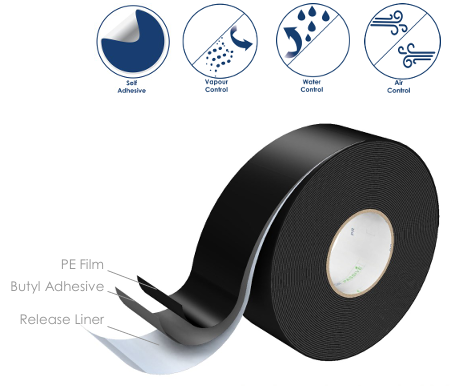 Product Description
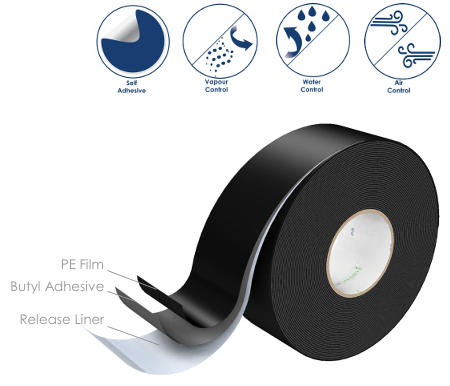
ProctorPassive YouByute Sealing Tape is a water resistant PE butyl rubber tape with high tack, very high ageing resistance, and high tear strength.
Applications
ProctorPassive YouByute Sealing Tape is used for diffusion tight and watertight sealing behind façades and around windows and doors where not exposed to long term UV. The tape is also used for improving nail and screw penetration sealing.
Installation
As with all pressure sensitive butyl tapes, the YouByute Sealing Tape should be bonded as tension-free as possible. In order to ensure a strong bond, apply pressure with a squeegee or roller when applying the tape. Adhesion can be improved by applying higher pressure. PE Film Butyl Adhesive Release Liner Properties The tape must not to be used for bonding under mechanical load. The use of tape is not a substitute for any required fixing of materials. Surfaces being adhered must be dry and free of surfactants, tensides, release agents like grease or oil, and dirt or dust. The tape is resistant against oil and many organic solvents. Damp or cold surfaces may prove difficult to adhere to and should be allowed to dry and return to a temperature between +5°C + 40°C prior to application of tape. It is recommended that porous or sandy surfaces being adhered to are preconditioned with a suitable primer. Due to the risk of plasticizer migration, the product‘s suitability on plastics and rubber should be tested.
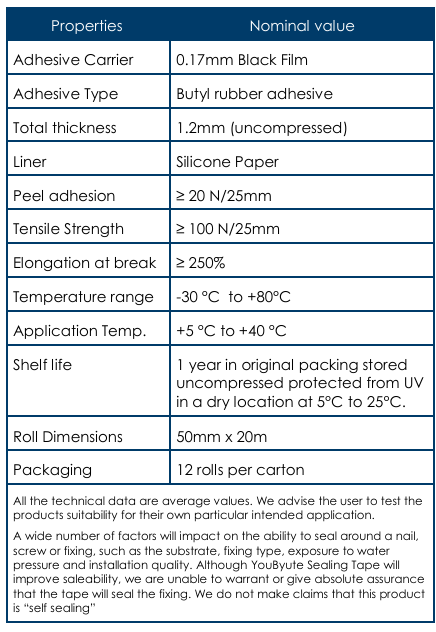
ProctorPassive YouByute Sealing Tape — Butyl Tape for Window & Door Junctions
Window and door openings are where an airtight building envelope usually gives up first. Every frame junction is a break in the membrane, a change of substrate, and a spot where movement between materials over time can open a gap that wasn't there on install day. YouByute Sealing Tape is a butyl sealing tape built specifically for that junction — where the membrane meets the frame and needs to stay sealed for the life of the building, not just the first year.
Window and door junctions are structurally and thermally different from the rest of the wall assembly in almost every respect — different materials meeting at the frame, different expansion and contraction rates, and typically more movement over the life of the building than a continuous wall section experiences. It's not surprising that building envelope failures cluster around these junctions more than almost anywhere else in a typical building — which is exactly why they deserve a purpose-built sealing product rather than whatever general tape happens to be handy on install day.
Why Butyl for Window and Door Sealing
What Butyl Does That Acrylic Doesn't
Acrylic tape, like HighTack Plus, is built for membrane-to-membrane laps which are flat, similar substrates, similar movement characteristics. A window or door junction is a different problem: dissimilar materials (membrane, timber or aluminium frame, sometimes masonry) moving at different rates as temperature changes. Butyl's adhesive stays pliable rather than setting hard, so it keeps its seal as the frame and the wall move independently of each other over time.
This distinction matters more than it might first appear. An aluminium window frame expands and contracts at a different rate to the timber or steel framing around it, and both move differently again to a membrane that's designed to flex with wind load rather than thermal cycling. A tape that sets hard after application effectively locks these different materials together at a fixed relationship, which then cracks or delaminates the first-time thermal movement pulls them apart at a rate the hardened adhesive can't accommodate.
Long-Term Seal, Not Just Install-Day Seal
A window seal that looks fine on handover but fails in three years is a callback waiting to happen. Butyl's ongoing flexibility is what's meant to prevent that the tape is still moving with the building long after the crew's left site. This is one of the harder qualities to demonstrate at handover, because a freshly installed seal generally looks identical on day one.
The real difference shows up years later, which is exactly why the adhesive chemistry matters more than it might seem to a client focused on how the finished job looks right now.
Window and Door Sealing Tape in Practice
Applied around the frame junction where the wall membrane meets the window or door unit, the point where wind and water intrusion is most likely if the seal isn't right, and where a failure is hardest to spot until there's already damage behind the wall lining.
Window and door junction failures are notoriously difficult to diagnose after the fact, because water or air intrusion at the frame can travel some distance before it becomes visible as staining, mould, or a draught the occupant notices. By the time a problem is visible, the damage behind the lining can already be significant which makes getting the seal right during install considerably more valuable than trying to fix it retrospectively.
Sequencing Around the Frame
A correctly sequenced window or door installation generally follows a specific order for how the membrane, flashing and sealing tape integrate around the frame, so that water is always directed outward and downward rather than being able to track back behind the frame at any point in the sequence. Getting this sequencing right matters as much as the tape's own adhesive performance, even the best sealing tape can't compensate for water being directed the wrong way by an incorrect install sequence.
Passive House Tape for the Australian Market
Why Passive House Standards Matter Here
Passive house building relies on a genuinely continuous airtight envelope. Window and door junctions are exactly where that continuity is hardest to hold, which is why passive house projects specify tape performance more rigorously than standard residential or commercial builds.
Passive house certification typically requires an airtightness test like a blower door test measuring actual air leakage through the completed envelope rather than relying on assumed performance from the specified materials.
That testing regime is part of why passive house builds treat junction sealing so seriously: a leak at a window junction that might go unnoticed on a standard build will show up directly in the test result on a passive house project, with no room to hide a poor detail behind an otherwise reasonable overall spec.
Built for Australian Conditions
Passive house tape products developed overseas don't always carry the same performance in Australian UV and climate conditions. YouByute Sealing Tape is supplied into the Australian market as part of the ProctorPassive range specifically for local passive house and high-performance builds.
Part of the ProctorPassive System
YouByute Sealing Tape sits within the broader ProctorPassive range alongside YouByute Flexi Tape, and the wider ProctorWrap membrane and lap tape system is worth speccing together on a passive house or high-performance build rather than mixing brands at the junctions where continuity matters most.
A passive house or high-performance build is only as airtight as its weakest detail, and mixing sealing products from different manufacturers at different junctions introduces variables that are hard to account for when something eventually needs to be diagnosed or repaired.
Speccing one matched system across the membrane, laps, penetrations and window junctions removes that variable and gives a single point of reference to work from across the whole envelope.
Frequently Asked Questions
Why use butyl tape instead of acrylic for window and door junctions?
Butyl stays pliable rather than setting hard, so it keeps sealing as the window frame and wall move independently with temperature changes over time. Acrylic tape is better suited to flatter, more similar-substrate laps like membrane-to-membrane joins.
Is this tape specifically for passive house builds, or can it be used on standard builds too?
It's developed for passive house airtightness standards, but the same long-term seal at a window or door junction is useful on any build where you don't want a callback for a leak in a few years.
Does this replace the lap tape used on the rest of the membrane?
No. it's specifically for window and door frame junctions. HighTack Plus or your standard lap tape still covers the general membrane laps; YouByute Sealing Tape covers the junction points where membrane meets frame.
How does this relate to YouByute Flexi Tape?
Both are part of the ProctorPassive airtightness range but built for different applications like Flexi Tape covers small fixing point penetrations across the field of the membrane, while Sealing Tape covers the more substantial junction where membrane meets a window or door frame. Confirm with the data sheet if you're unsure which is right for a specific detail.
(BUSEAL)
| SKU | BUSEAL |
Be The First To Review This Product!
Help other WP Supplies users shop smarter by writing reviews for products you have purchased.